Abstract
Objective of this study was to investigate the effects of low ambient temperatures (–14.2 °C) on microclimate, behaviour, and welfare indicators of calves housed in individual hutches located either outdoors under shelters or indoors in a lightweight prefabricated building (indoor vs. outdoor housing). Research was conducted on a dairy farm in Ukraine using Holstein calves. Air temperature in hutches located indoors was 4.8 °C higher (p < 0.001), while wind speed was 4.2 km h−1 lower (p < 0.001) compared with outdoor hutch placement. Calves housed indoors had a significantly higher skin temperature (+2.7 °C; p < 0.001). Also, these calves spent more time standing (+15 min day−1; p < 0.01), moving (+7 min day−1; p < 0.001), and drinking water (+4 min day−1; p < 0.01). However, the duration of concentrate intake and the total time spent inside the individual hutches were longer in calves housed outdoors under shelters (+9 min, p < 0.05; and +17 min, respectively). Better average faecal scores were observed in calves housed outdoors (+0.04; p < 0.05).
Key words: cold stress, individual hutches, bioclimatic indices, feeding behaviour, faecal quality, respiratory diseases
Introduction
The effects of weather-related factors on the welfare and productivity of cattle have been studied predominantly in the context of high ambient temperatures (Oliveira et al. 2025). In contrast, the role of cold exposure has been investigated mainly in beef cattle (Graunke et al. 2011, Wang et al. 2023) or in dairy cattle under year-round pasture-based systems (Wang et al. 2023, Debnath et al. 2024). Nevertheless, low ambient temperatures can adversely affect cattle even under indoor housing conditions (Herbut 2013).
Cold weather influences both physiological responses and behavioural patterns in cattle (Rutherford et al. 2020, Borshch et al. 2021). Exposure to cold stress activates the sympathetic nervous system, eliciting three primary physiological responses: an increase in metabolic heat production, elevated heart rate, and mobilisation of free fatty acids to support energy metabolism (Brouček et al. 1991).
Behavioural responses to low ambient temperatures can be classified into two main categories: the animal’s active seeking of warm and comfortable resting areas to mitigate thermal exposure, and adjustments in the duration of main behavioural activities (Borshch et al. 2019).
Weather conditions, together with microclimatic parameters, play a crucial role in calf rearing, particularly during the first weeks of life (Setser et al. 2024, Angrecka and Kochanek 2026). Winter housing strategies for calves are primarily determined by regional climatic characteristics (Hepola et al. 2006, Klein-Jöbstl et al. 2014, Costa Freitas et al. 2020, Armengol et al. 2021). Therefore, to ensure calf comfort and welfare – thereby supporting adequate growth and development and maintaining recommended durations of behavioural activities – both the housing system (individual vs. group) and housing location (indoor vs. outdoor) are of critical importance (Unsal et al. 2025).
In Ukraine, the majority of dairy farms were established prior to 1991, and cattle are predominantly housed in brick-built facilities (73 × 21 × 4.5 m; length × width × height) using either tie-stall systems or structures subsequently retrofitted for loose housing (Ruban et al. 2020). Housing calves during the early postnatal period under such conditions does not consistently support optimal growth performance and may be associated with an increased incidence of respiratory and gastrointestinal disorders (Ugurlu et al. 2014, Koralesky et al. 2025). These challenges are particularly pronounced during periods when ambient temperatures fall outside the thermoneutral zone for calves.
Seasonal effects on calf viability have been documented, with Gulliksen et al. 2009, reporting lower survival during the first week of life in calves born in winter compared with those born in summer in Norwegian dairy herds. To attenuate the negative impact of low ambient temperatures on calf physiology and health, a range of mitigation strategies – including genetic selection, nutritional management, and housing- and technology-based interventions – have been proposed and implemented (Ignătescu et al. 2018).
In calf-rearing systems based on individual or paired hutches, as well as group pens, a range of technological measures is commonly implemented to mitigate adverse environmental conditions. These measures include locating hutches inside buildings (Wormsbecher et al. 2017), installing shelters or shades to protect calves from precipitation and wind exposure (Hoshiba 1986, Gingerich et al. 2020), and the use of calf jackets during the early postnatal period (Scoley et al. 2019). Despite widespread adoption, the effectiveness of these strategies in alleviating cold-related challenges remains inconsistent across housing environments.
Calf housing systems differ substantially in their implications for health and welfare. Individual hutch housing limits direct contact between animals and reduces the risk of pathogen transmission (Donadio et al. 2025), whereas group housing is generally preferred from a welfare perspective due to its positive effects on cognitive development (Gaillard et al. 2014), locomotor activity, and social behaviour (von Keyserlingk et al. 2009). However, both systems are highly sensitive to environmental conditions, particularly under cold stress.
The establishment of an appropriate microclimate and the expression of normal daily behavioural patterns are strongly influenced by housing design and management factors, including hutch dimensions and structure (Færevik et al. 2008), space allowance (≥3.3 m2 per calf), ventilation efficiency, and bedding management (Nordlund and Halbach 2019). Nevertheless, empirical evidence comparing indoor and outdoor placement of individual calf hutches under low ambient temperatures remains limited.
Therefore, the objective of this study was to assess the effects of low ambient temperatures on microclimate characteristics, behavioural responses, and welfare indicators of calves housed in individual hutches located either outdoors or indoors within lightweight prefabricated structures (indoor vs. outdoor housing).
Materials and methods
The study was conducted on a commercial dairy farm located in the Kyiv region, central Ukraine (49°51′27″ N, 30°06′36″ E), during December–January of the 2025–2026 winter season, a period characterised by pronounced low-temperature exposure. The farm is situated within the forest-steppe agroclimatic zone. Throughout the study period, north-eastern air masses predominated.
Data on mean daily ambient temperature, relative humidity, wind speed, and precipitation were obtained from the Ukrainian Hydrometeorological Center of the State Emergency Service of Ukraine. Weather conditions during the experimental period are summarised in Table 1. The farm maintains a herd of 820 Holstein dairy cows housed under a loose housing system with cubicles in lightweight prefabricated barns. The average annual milk yield of the herd is 10 100 kg per cow.
| Parameters | Mean ± | Min | Max |
|---|---|---|---|
| Temperature, °C | −14.2 ± 3.44 | −21.4 | −8.7 |
| Relative humidity, % | 87.2 ± 4.19 | 81.8 | 94.6 |
| Wind speed, km h−1 | 38 ± 3.76 | 17.9 | 57.4 |
| Mean daily precipitation, mm | 4.9 ± 0.48 | 0.4* | 18.3* |
*minimum and maximum daily precipitation (24 h)
Calving takes place in individual maternity pens within the calving unit, and calves are separated from their dams on the second day postpartum. During the first two days of life, calves are fed colostrum two to three times daily. Calves are housed individually in CalfOTel hutches with an attached outdoor pen (Netherlands) until 35 days of age. The calf hutches are constructed from durable polyester reinforced with fiberglass. The dimensions (length × width × height) of the hutch are 1.96 × 1.15 × 1.28 m, and those of the outdoor pen are 1.50 × 1.20 × 1.00 m. Milk feeding was continued alongside starter provision according to the farm’s standard management protocol. Fresh drinking water was available ad libitum via nipple drinkers throughout the experimental period. Feed refusals were recorded daily to monitor intake, and feeding equipment was cleaned regularly to maintain hygienic conditions.
For the experiment, two groups of heifer calves (n = 18 in each group) aged 5 days with a mean body weight of 35.4 ± 0.76 kg were formed. Only clinically healthy, active calves without signs of colibacillosis, dyspepsia, or respiratory disease during the first four days of life were included. During the first four days postpartum, calves remained in the maternity unit with their dams, where the mean daily ambient temperature was 4.3 ± 0.76 °C, and they consumed maternal colostrum. From day 5 of life onwards, calves were gradually introduced to a starter concentrate diet (Table 2).
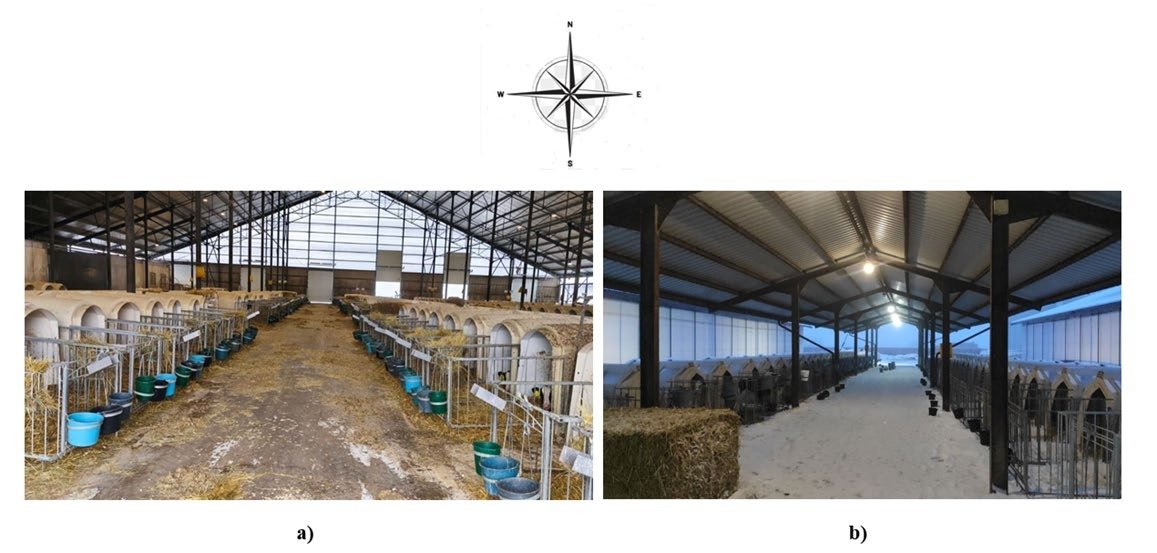
Calves in both groups were trained to drink milk and water from individual nipple drinkers. The first group (n = 18) was housed in individual hutches arranged in four rows within a prefabricated building (Fig. 1a; 50 × 21 × 8.5 m, L × W × H). The second group (n = 18) was housed in individual hutches arranged in two rows in an open area under shelters (Fig. 1b; 75 × 12 × 4.5 m, L × W × H). Calves were fed milk twice daily at 09:00 and 18:00. Milk was delivered to buckets using a MilknRoll Mobile milk taxi (Turkey) with a pasteurization function. The milk feeding temperature was maintained at 38 °C.
In both cases, the individual calf hutches were placed on concrete surfaces. A straw bedding layer of approximately 200–300 mm was provided inside the hutches and within the adjacent pens. The straw bedding was replaced daily.
Daily calf behaviour was recorded using Hikvision DS-2CE17D0T-IT5F video cameras (PRC) installed at the beginning and end of the building and shelters, oriented toward the aisle between rows of calf hutches (n = 8 cameras). Every 10 min, the total time calves spent in calf hutches, as well as the duration of concentrate intake, drinking, walking, and standing, was recorded. Additionally, the number of visits to drinkers and feeders, the duration of each visit, and the intervals between visits were determined. Calf body weight at the beginning and end of the study was measured using a VTP-G-1020 scale (Ukraine).
| Item | Amount (%) |
|---|---|
| Maize | 34.00 |
| Wheat | 9.07 |
| Barley | 9.78 |
| Sunflower meal | 19.06 |
| Soybean meal | 23.59 |
| Salt | 1.00 |
| Limestone | 2.20 |
| Sodium bicarbonate | 1.30 |
Mean daily air temperature, relative humidity, wind speed, and precipitation were obtained from the Kyiv Hydrometeorological Center. Daily microclimate parameters (air temperature, relative humidity, and air velocity) inside the building and under the shelters were recorded using TFA Weather Pro meteorological stations (TFA Dostmann GmbH, Germany). Sensors were placed at the edges and in the centre of the building and shelters at a height of 0.5 m. Measurements were recorded hourly.
Calf skin surface temperature was measured at two sites (rumen region and the last intercostal space) using a remote infrared thermometer (Thermo Spot Plus, Germany). Temperature at the resting area and under lying calves was measured using a thermometer (A36PF-D43, USA). Skin and resting surface temperatures were recorded twice daily during milk feeding.
The wind chill temperature index (WCT1) was calculated according to Tucker et al. 2007. The WCT2 and WCT3 indexes were calculated from the data of wind protection effects, using the following equation (ASHRAE 1981). This indexes helps to evaluate the effect of low air temperature in combination with the wind speed on the cold stress of animals.
Where: WCT – wind chill temperature index, °C, Tair – air temperature, °C, V – wind speed, km h−1. Characteristics of WCT1 levels: > 0 °C – No cold stress (animals are generally comfortable); 0 to −10 °C – Mild cold stress (increased metabolic heat production may occur); −10 to −20 °C – Moderate cold stress (animals may seek shelter); −20 to −30 °C – Severe cold stress (risk for young or weak animals); < −30 °C – Extreme cold stress (high risk of hypothermia).
WCI2 was classified as: < 300 kcal hr−1m−2 – Mild cooling (little discomfort); 300–600 kcal hr−1m−2 – Cool conditions (noticeable cold sensation); 600–900 kcal hr−1m−2 – Very cold (prolonged exposure may cause cold stress); 900–1200 kcal hr−1m−2 – Severe cold (protective clothing recommended); 1200–1600 kcal hr−1m−2 – Extreme cold (high risk of frostbite on exposed skin); > 1600 kcal hr−1m−2 – Dangerous cold (rapid frostbite possible).
Where: V – wind velocity, ms−1, ta – air temperature, °C. WCI3 was classified as: < 350 W m−2 – Mild cooling; 350–700 W m−2 – Cool conditions; 700–1050 W m−2 – Very cold; 1050–1400 W m−2 – Severe cold; 1400–1850 W m−2 – Extreme cold; > 1850 W m−2 – Dangerous cold.
The cold stress index (CSI), which indicates the level of animals’ resistance to stress caused by high wind speed and precipitation, was determined using the method described by Donnelly (1984):
Where: CSI – cold-stress index, MJ m−2h−1, WS – mean daily wind speed, m s−1, T – is the mean daily temperature, °C.
Where: rain is the total daily rainfall in millimeters, e – natural logarithm = 2.718.
CSI was classified as: Low (Minimal stress): 800–900 kJ m−2h−1; Moderate stress: ~900–1100 kJ m−2h−1; High (Severe stress): ~1000–1250 kJ m−2h−1; Very high (Extreme stress): > 1250 kJ m−2h−1.
Faecal consistency was assessed daily throughout the study during the morning milk feeding using a qualitative scoring system, where 1 = normal consistency, 2 = slightly liquid, 3 = moderately liquid, and 4 = primarily liquid faeces (Quigley et al. 2006). Calves were classified as having diarrhoea when the faecal score exceeded 2. Respiratory disease scoring, with the exception of rectal temperature, was also performed daily according to the protocol described by McGuirk and Peek 2014. This assessment included three visual parameters – eye appearance, ear position, and nasal discharge – as well as the presence or absence of coughing. Each parameter was scored on a scale from 0 to 3, where 0 indicated normal condition and 3 indicated severe abnormality. The overall respiratory score was calculated as the sum of individual parameter scores. Cases of calf ill health were evaluated on an individual basis.
Data are presented as means ± standard error of the mean (SEM). Distribution was tested for normality using the Shapiro–Wilk test. A non-parametric Mann–Whitney U test was employed to determine differences between groups. All statistical analyses were conducted using Statistica software (v. 11.0, 2012). With differences denoted as ap < 0.05, bp < 0.01, and cp < 0.001.
Results
It was established that the placement of individual calf hutches inside a prefabricated building during the period of low-temperature exposure significantly affected microclimate parameters and bioclimatic indices (Table 3). Air temperature was 4.8 °C higher compared with the outdoor housing system under shelters. Relative humidity was 7.6 percentage points lower, and wind speed was 4.2 km h−1 lower under indoor housing conditions.
To assess the impact of cold stress on calves, three wind chill indices (WCI), which indicate the rate of heat loss and reflect the combined effect of air movement and temperature, were calculated. According to these indices, more favourable conditions were observed when calves were housed in individual hutches indoors. Regarding the Cold Stress Index (CSI), which is used to evaluate animal resistance to strong wind and precipitation, more favourable values were also observed for calves housed indoors (by 153 359 MJ m−2 h−1). However, under both housing systems, CSI values exceeded 947 MJ m−2 h−1, indicating a substantial effect of wind and temperature on the animals.
| Parameters | indoor | outdoor |
|---|---|---|
| Temperature, °C | −8.9 ± 0.97 | −13.7 ± 0.39c |
| Relative humidity, % | 78.6 ± 2.88 | 86.2 ± 1.97 |
| Wind speed, km·h−1 | 2.2 ± 0.53 | 6.4 ± 0.66c |
| Wind-Cold index 1, °C | −11.33 ± 0.67 | −30.38 ± 1.19c |
| Wind-Cold index 2, kcal hr−1m−2 | 739.53 ± 9.198 | 1026.46 ± 11.316a |
| Wind-Cold index 2, W m−2 | 860.07 ± 10.742 | 1193.77 ± 11.107a |
| Cold-stress index, MJ m−2h−1 | 1246.612 ± 58.2319 | 1406.003 ± 43.7436 |
Note: compared with the indoor housing of calves in individual hutches: ap < 0.05; cp < 0.001.
During the period of low-temperature exposure, bedding temperature on the area in front of the individual calf hutch and inside the hutch was higher by 3.4 and 3.1 °C, respectively, compared with calves housed in the lightweight prefabricated barn (Table 4). The temperature of the resting area beneath lying calves was also higher by 2.1 °C under indoor hutch housing than under housing in the prefabricated barn. In addition, the mean skin temperature of calves was 2.7 °C higher in the indoor hutch system compared with indoor housing.
| Parameters | indoor | outdoor |
|---|---|---|
| Calf skin temperature, °C | 28.9 ± 0.28 | 26.2 ± 0.12c |
| Bedding temperature in the pen area in front of the hutch, °C | −8.9 ± 0.52 | −12.3 ± 0.70b |
| Bedding temperature inside the hutch, °C | −8.0 ± 0.76 | −11.1 ± 0.43b |
| Temperature beneath lying calves, °C | 22.4 ± 0.26 | 20.3 ± 0.49c |
Note: compared with the indoor housing of calves in individual hutches: bp < 0.01; cp < 0.001.
Analysis of the calves’ daily behavior showed that under indoor housing conditions calves spent more time standing, moving, and drinking water or milk, by 15, 7, and 4 min, respectively, compared with outdoor housing (Table 5). However, the average duration of time spent inside individual hutches and the time devoted to concentrate intake were longer when calves were housed under shelters, by 17 and 9 min, respectively.
| Parameters | indoor | outdoor |
|---|---|---|
| Time spent inside the hutch | 1263 ± 14.77 | 1280 ± 9.43 |
| Standing in the pen | 63 ± 2.63 | 48 ± 1.13b |
| Moving in the pen | 41 ± 0.29 | 34 ± 0.16c |
| Concentrate intake | 53 ± 0.94 | 62 ± 1.17a |
| Drinking water or milk | 20 ± 0.77 | 16 ± 0.52b |
Note: compared with the indoor housing of calves in individual hutches: ap < 0.05; bp < 0.01; cp < 0.001
Under the housing system with individual calf hutches placed indoor, a slightly higher number of visits to drinkers and feeders was observed, by 0.5 visits (Table 6).
At the same time, the intervals between visits to drinkers and feeders were shorter by 19.1 min. The duration of a single visit to feeders and drinkers was also shorter by 2.3 min. With regard to average daily body weight gain, calves housed indoors exhibited values that were higher by 0.022 kg compared with calves housed in the outdoor system.
| Parameters | indoor | outdoor |
|---|---|---|
| Number of visits to drinkers and feeders, times | 6.3 ± 0.2 | 5.8 ± 0.2 |
| Intervals between visits, min | 218.5 ± 6.6 | 237.6 ± 8.1 |
| Duration of a single visit to drinkers and feeders, min | 8.4 ± 0.4 | 10.7 ± 0.7a |
| Average daily body weight gain of calves during periods of low ambient temperature, kg | 0.414 ± 0.0519 | 0.392 ± 0.0482 |
Note: compared with the indoor housing of calves in individual hutches: ap < 0.05
With respect to the assessment of fecal consistency in calves, slightly better mean scores were observed under outdoor housing conditions (Table 7), by 0.04 units. In contrast, mean scores for respiratory health were marginally better in calves housed indoors, by 0.01 units. However, the differences observed of average respiratory score were not statistically significant.
| Parameters | indoor | outdoor |
|---|---|---|
| Average faecal score | 1.08 ± 0.014 | 1.04 ± 0.012a |
| Average respiratory score | 0.07 ± 0.067 | 0.08 ± 0.054 |
Note: compared with the indoor housing of calves in individual hutches: ap < 0.05.
Discussion
Among weather-related factors influencing the performance and physiological functioning of dairy cattle, ambient temperature plays a decisive role (Ahmed et al. 2022). In mammals, a specific range of environmental temperatures exists within which endogenous heat production generated by basal metabolism is sufficient to maintain a stable core body temperature (Fernández-Peña et al. 2023). This range is defined as the thermoneutral zone, within which animals express their optimal metabolic efficiency (Cannon and Nedergaard 2010). Under thermoneutral conditions, the energetic costs associated with thermoregulation and maintenance of homeostasis are minimized. Knizkova et al. 2002, reported that the thermoneutral zone for adult dairy cattle ranges from −5 to 25 °C, while West 2003, indicated that fluctuations in ambient temperature between −0.5 and +25 °C do not adversely affect milk production. In young calves, the thermoneutral zone is more variable and depends on age, body weight, environmental conditions, and the presence of additional stressors, typically ranging from 15 to 25 °C (Davis and Drackley 1998).
Exposure to cold stress in ruminants results in increased feed intake, as a greater proportion of dietary energy is redirected toward thermogenesis (Litherland et al. 2014). However, under low ambient temperatures, increased feed provision only partially compensates for the elevated heat production demands, which may ultimately lead to reduced productive performance (Manzoor et al. 2021). A reduction in feeding duration further compromises cold tolerance, particularly in young calves, whose limited body fat reserves are rapidly depleted (Scott et al. 1993, NRC 2001). To mitigate the increased metabolic burden during winter, Anderson and Bates 1984, recommended increasing milk allowance to up to 15% of calf body weight.
Behavioral patterns are commonly used as indicators of animal comfort and welfare, with lying and standing durations serving as key measures for evaluating housing conditions and bedding quality (Sreekumar and Sejian 2024). Gibbons et al. 2012, reported that calves spend more time lying during periods of low ambient temperature compared with thermoneutral or warm conditions. Sinnott et al. 2021, demonstrated that lying is the dominant behavioral activity during the early postnatal period, while Sinnott et al. 2022, observed longer lying and standing times in individually housed calves compared with group-housed calves during the winter–spring period. These observations are partially consistent with the findings of the present study. In particular, calves housed outdoors exhibited lower body weight gains compared with those housed indoors. Additionally, decreasing ambient temperature was associated with reduced social activity and increased time spent lying.
Consistent with these findings, Okamoto et al. 1993, reported longer milk replacer consumption times in calves reared outdoors during winter compared with those reared indoors. Outdoor-housed calves are generally more exposed to adverse environmental conditions due to faster heat loss from housing structures (Nordlund 2008). Jensen et al. 2015, further demonstrated that the duration of time calves spent inside hutches was influenced by the level of atmospheric precipitation. Wormsbecher et al. (2017), studying Holstein calves in Canada, found that outdoor housing in individual hutches resulted in shorter lying and standing durations compared with indoor housing. Similarly, Hoshiba 1986, observed that calves exposed to low ambient temperatures spent most of the day lying inside individual hutches. Reuscher et al. 2024, investigating individual and pair housing of calves in outdoor hutches during a continental winter in Wisconsin (USA), reported that individually housed calves spent a greater proportion of time inside the hutch than pair-housed calves (93.9 vs. 90.7% of total time, respectively).
The results of the present study partially align with those reported by Wójcik et al. 2013, who observed slightly lower weight gains in calves housed outdoors in individual hutches during the cold season compared with calves housed indoors; however, in that study, indoor-housed calves were kept in group pens rather than individual hutches. Hill et al. 2011, similarly reported higher growth rates in calves housed indoors, whereas Earley et al. 2004, found no significant differences in weight gain between calves individually housed indoors or outdoors.
Scibilia et al. 1987, documented lower daily weight gains, reduced water intake, decreased rectal temperature, and respiration rate, along with a 32% increase in maintenance energy requirements in calves reared at −4 °C compared with those maintained at 10 °C. In contrast, Scoley et al. 2019, in autumn–winter trials conducted in Northern Ireland, reported no differences in growth performance between group-housed calves fitted with thermal jackets and those without jackets. Nevertheless, calves without jackets visited feeders more frequently, whereas jacketed calves exhibited a higher skin surface temperature (+6.37 °C), findings that are consistent with those reported by Zhang et al. 2021. Nonnecke et al. 2009, observed similar growth rates in calves housed in warm and cold microclimates; however, calves exposed to colder conditions (4.7 °C) consumed more concentrate feed than those housed under warmer conditions (15.5 °C). Additionally, relative humidity was approximately 10% higher in cold housing environments, which corresponds with the results of the present study.
Comparative studies by Svensson and Liberg 2006, indicated lower mortality rates, higher growth performance, and longer feeding durations in calves housed outdoors compared with those housed indoors. Earlier studies by Davis et al. 1954, and Richard et al. 1988, also reported greater body weight gains under outdoor housing conditions. Furthermore, Nilsson 2012 and Wójcik et al. 2012, documented reduced incidences of respiratory and gastrointestinal diseases in calves housed outdoors. Conversely, Nonnecke et al. 2009, reported a higher prevalence of respiratory disorders in calves housed in cold and humid environments compared with warm and dry conditions. Hänninen et al. 2003, observed fewer cases of diarrhea in calves housed indoors in small groups than in calves housed outdoors with or without shelter, while Klein-Jöbstl et al. 2014, reported a higher incidence of diarrhea in Austrian dairy calves housed outdoors compared with those kept in individual hutches inside barns. At the same time, in our opinion, one of the limitations of this study is that observations were conducted during only a single winter, whereas winters in central Ukraine are typically considerably warmer than those recorded in 2025–2026. The study period was therefore limited to late December through late January, as temperatures during the first and third winter months (December and February) were substantially higher. In addition, biological indicators of stress (cortisol, non-esterified fatty acids, glucose, β-hydroxybutyrate, rectal temperature, or heart rate) were not assessed; their inclusion would undoubtedly have increased the accuracy of stress level evaluation in the animals.
Conclusion
It was established that indoor placement of individual calf hutches significantly influenced the microclimatic environment, bioclimatic indices, and calf behavior during prolonged exposure to low ambient temperatures. In particular, the mean daily air temperature was higher by 4.8 °C, and wind speed differed by 4.2 km h−1. Calves housed indoors also exhibited a higher mean skin temperature (+2.7 °C). More favorable values of the wind chill index (WCI) and cold stress index (CSI) were likewise recorded under indoor housing conditions.
Under this housing system, calves spent more time standing (+15 min day−1), moving (+7 min day−1), and drinking water (+4 min day−1). In contrast, calves housed outdoors under shelters spent longer periods consuming concentrate and remained inside individual hutches for a greater proportion of the day, by 9 and 17 min day−1, respectively. No statistically significant differences in average daily live weight gain were detected between housing systems differing in the placement of individual calf hutches.
References
- Ahmed, H., Tamminen, L.M. & Emanuelson, U. 2022. Temperature, productivity, and heat tolerance: Evidence from Swedish dairy production. Climatic Change 175: 10. https://doi.org/10.1007/s10584-022-03461-5
- Anderson, J.F. & Bates, D.W. 1984. Clinical cold stress in calves: Identification, environmental considerations, treatment and prevention. The Bovine Practitioner 19: 22–25. https://doi.org/10.21423/bovine-vol1984no19
- Angrecka, S. & Kochanek, A. 2026. Do Calf Hutches Provide Thermal Comfort for Animals in Winter? Agriculture 16: 113. https://doi.org/10.3390/agriculture16010113
- Armengol, R., Bassols, M. & Fraile, L. 2021. A cow-calf farming system fully adapted to elevation and harsh conditions in Andorra (Europe). Animals 11: 611. https://doi.org/10.3390/ani11030611
- ASHRAE 1981. Physiological principles, comfort, and health. Chpt. 8 in ASHRAE Handbook 1981. Fundamentals. ASHRAE. Atlanta, GA. p. 17.
- Borshch, A.A., Ruban, S., Borshch, A.V. & Babenko, O.I. 2019. Effect of three bedding materials on the microclimate conditions, cows behavior and milk yield. Polish Journal of Natural Science 34: 19–31.
- Borshch, O.O., Borshch, O.V., Mashkin, Yu., Malina, V. & Fedorchenko, M. 2021. Behavior and energy losses of cows during the period of low temperatures. Scientific Horizons 24: 46–53. https://doi.org/10.48077/scihor.24(5).2021.46-53
- Brouček, J., Letkovičová, M. & Kovalčuj, K. 1991. Estimation of cold stress effect on dairy cows. International Journal of Biometeorology 35: 29–32. https://doi.org/10.1007/BF01040960
- Cannon, B. & Nedergaard, J. 2010. Metabolic consequences of the presence or absence of the thermogenic capacity of brown adipose tissue in mice (and probably in humans). International Journal of Obesity 34: S7–S16. https://doi.org/10.1038/ijo.2010.177
- Costa Freitas, M.D.B., Ventura-Lucas, M.R., Izquierdo, L. & Deblitz, C. 2020. The montado/dehesa cow-calf production systems in Portugal and Spain: An economic and resources’ use approach. Land 9: 148. https://doi.org/10.3390/land9050148
- Davis, C.L. & Drackley, J.K. 1998. The development, nutrition, and management of the young calf. Iowa State University Press. Wiley Blackwell.
- Davis, L.R., Autrey, K.M., Herlich, H. & Hawkins Jr, G.E. 1954. Outdoor individual portable pens compared with conventional housing for raising dairy calves. Journal of Dairy Science 37: 562–570. https://doi.org/10.3168/jds.S0022-0302(54)91299-0
- Debnath, A., Elangbam, S., Pandey, A., Madhuri, P. & Michui, D. 2024. The hidden dangers of winter: A brief review how cold stress affects cattle production. International Journal of Veterinary Sciences and Animal Husbandry 9: 152–153. https://dx.doi.org/10.22271/veterinary.2024.v9.i6c.1852
- Donadio, J.P., De-Sousa, K.T., Torres, R.D.N.S., Alves, T.C., Hötzel, M.J. & Deniz, M. 2025. A meta-analysis approach to evaluate the effects of early group housing on calf performance, health, and behavior during the preweaning period. Journal of Dairy Science 108: 954–967. https://doi.org/10.3168/jds.2024-25159
- Donnelly, J.R. 1984. The productivity of breeding ewes grazing on lucerne or grass and clover pastures on the tablelands of southern Australia. III. Lamb mortality and weaning percentage. Australian Journal of Agricultural Research 35: 709–721. https://doi.org/10.1071/AR9840709
- Earley, B., Murray, M., Farrell, J.A. & Nolan, M. 2004. Rearing calves outdoors with and without calf jackets compared with indoor housing on calf health and live-weight performance. Irish Journal of Agricultural and Food Research 43: 59–67.
- Færevik, G., Tjentland, K., Løvik, S., Andersen, I.L. & Bøe, K.E. 2008. Resting pattern and social behaviour of dairy calves housed in pens with different sized lying areas. Applied Animal Behaviour Science 114: 54–64. https://doi.org/10.1016/j.applanim.2008.01.002
- Fernández-Peña, C., Reimúndez, A., Viana, F., Arce, V.M. & Señarís, R. 2023. Sex differences in thermoregulation in mammals: Implications for energy homeostasis. Frontiers in Endocrinology 14: 1093376. https://doi.org/10.3389/fendo.2023.1093376
- Gaillard, C., Meagher, R.K., Von Keyserlingk, M.A. & Weary, D.M. 2014. Social housing improves dairy calves’ performance in two cognitive tests. PloS One 9(2): e90205. https://doi.org/10.1371/journal.pone.0090205
- Gibbons, J., Medrano-Galarza, C., de Passillé, A.M. & Rushen, J. 2012. Lying laterality and the effect of IceTag data loggers on lying behaviour of dairy cows. Applied Animal Behaviour Science 136: 104–107. https://doi.org/10.1016/j.applanim.2011.12.005
- Gingerich, K.N., Choulet, V. & Miller-Cushon, E.K. 2020. Disbudding affects use of a shelter provided to group-housed dairy calves. Journal of Dairy Science 103: 10519–10529. https://doi.org/10.3168/jds.2020-18267
- Graunke, K.L., Schuster, T. & Lidfors, L.M. 2011. Influence of weather on the behaviour of outdoor-wintered beef cattle in Scandinavia. Livestock Science 136: 247–255. https://doi.org/10.1016/j.livsci.2010.09.018
- Gulliksen, S.M., Lie, K.I., Løken, T. & Østerås, O. 2009. Calf mortality in Norwegian dairy herds. Journal of Dairy Science 92: 2782–2795. https://doi.org/10.3168/jds.2008-1807
- Hänninen, L., Hepola, H., Rushen, J., De Passille, A.M., Pursiainen, P., Tuure, V.-M., Syrjälä-Qvist, L., Pyykkönen, M. & Saloniemi, H. 2003. Resting behaviour, growth and diarrhoea incidence rate of young dairy calves housed individually or in groups in warm or cold buildings. Acta Agriculturae Scandinavica, Section A – Animal Science 59: 35–47. https://doi.org/10.1080/09064700310002008
- Hepola, H., Hänninen, L., Pursiainen, P., Tuure, V.-M., Syrjälä-Qvist, L., Pyykkönen, M. & Saloniemi, H. 2006. Feed intake and oral behaviour of dairy calves housed individually or in groups in warm or cold buildings. Livestock Science 105: 94–104. https://doi.org/10.1016/j.livsci.2006.04.033
- Herbut, P. 2013. Temperature, humidity and air movement variations inside a free-stall barn during heavy frost. Annals of Animal Science 13: 587–596. https://doi.org/10.2478/aoas-2013-0025
- Hill, T.M., Bateman, H.G., Aldrich, J.M. & Schlotterbeck, R.L. 2011. Comparisons of housing, bedding, and cooling options for dairy calves. Journal of Dairy Science 94: 2138–2146. https://doi.org/10.3168/jds.2010-3841
- Hoshiba, S. 1986. Environmental characteristics of calf hutches. Journal of the Faculty of Agriculture, Hokkaido University 63: 64–103.
- Ignătescu, R.M., Goanță, A.M., Mihai, A. & Ioniță, L. 2018. A review of the adaptation of the newborn calf to its environment. Scientific Papers. Series D. Animal Science 61: 52–57.
- Jensen, M.B., Duve, L.R. & Weary, D.M. 2015. Pair housing and enhanced milk allowance increase play behaviour and improve performance in dairy calves. Journal of Dairy Science 98: 2568–2575. https://doi.org/10.3168/jds.2014-8272
- Klein-Jöbstl, D., Iwersen, M. & Drillich, M. 2014. Farm characteristics and calf management practices on dairy farms with and without diarrhea: A case-control study to investigate risk factors for calf diarrhea. Journal of Dairy Science 97: 5110–5119. https://doi.org/10.3168/jds.2013-7695
- Knizkova, I., Kunc, P., Koubkova, M., Flusser, J. & Dolezal, O. 2002. Evaluation of naturally ventilated dairy barn management by a thermographic method. Livestock Production Science 77: 349–353. https://doi.org/10.1016/S0301-6226(02)00062-3
- Koralesky, K.E., Dyck, T., Kuo, C., Von Keyserlingk, M.A. & Weary, D.M. 2025. Social housing for dairy calves: Farmer acceptance of Canadian industry-led requirements. Journal of Dairy Science 108: 12438–12449. https://doi.org/10.3168/jds.2025-26881
- Litherland, N.B., Da Silva, D.N.L., LaBerge, R.J., Schefers, J. & Kertz, A. 2014. Supplemental fat for dairy calves during mild cold stress. Journal of Dairy Science 97: 2980–2989. https://doi.org/10.3168/jds.2013-6942
- Manzoor, A., Kalkal, H., Ahuja, R., Argade, A. & Nazir, T. 2021. Effect of heat and cold stress and its management in dairy animals. Advanced Research in Veterinary Sciences 22: 82.
- McGuirk, S.M. & Peek, S.F. 2014. Timely diagnosis of dairy calf respiratory disease using a standardized scoring system. Animal Health Research Reviews 15: 145–147. https://doi.org/10.1017/S1466252314000267
- Nilsson, A. 2012. Calf health before and after change in housing system – Isolated barn vs. hutches. Swedish University of Agricultural Sciences, Department of Animal Environment and Health. Student report No. 453. 35 p.
- Nonnecke, B.J., Foote, M.R., Miller, B.L., Fowler, M., Johnson, T.E. & Horst, R.L. 2009. Effects of chronic environmental cold on growth, health, and select metabolic and immunologic responses of preruminant calves. Journal of Dairy Science 92: 6134–6143. https://doi.org/10.3168/jds.2009-2517
- Nordlund, K.V. & Halbach, C.E. 2019. Calf barn design to optimize health and ease of management. Veterinary Clinics: Food Animal Practice 35: 29–45. https://doi.org/10.1016/j.cvfa.2018.10.002
- NRC 2001. Nutrient Requirements of Dairy Cattle. 7th ed. National Academy Press, Washington DC.
- Okamoto, M., Sone, A. & Hoshiba, S. 1993. Comparison of performances of young calves in several housing systems in the winter of cold regions. Asian-Australasian Journal of Animal Science 6: 305–311. https://doi.org/10.5713/ajas.1993.305
- Oliveira, C.P., Sousa, F.C.D., Silva, A.L.D., Schultz, É.B., Valderrama Londoño, R.I. & Souza, P.A.R.D. 2025. Heat stress in dairy cows: impacts, identification, and mitigation strategies – a review. Animals 15: 249. https://doi.org/10.3390/ani15020249
- Quigley, J.D., Wolfe, T.A. & Elsasser, T.H. 2006. Effects of additional milk replacer feeding on calf health, growth, and selected blood metabolites in calves. Journal of Dairy Science 89: 207–216. https://doi.org/10.3168/jds.S0022-0302(06)72085-9
- Reuscher, K.J., Salter, R.S., da Silva, T.E. & Van Os, J.M. 2024. Comparison of behavior, thermoregulation, and growth of pair-housed versus individually housed calves in outdoor hutches during continental wintertime. Journal of Dairy Science 107: 2268–2283. https://doi.org/10.3168/jds.2023-23941
- Richard, A.L., Muller, L.D. & Heinrichs, A.J. 1988. Ad libitum or twice daily feeding of acidified milk replacer to calves housed individually in warm and cold environments. Journal of Dairy Science 71: 2193–2202. https://doi.org/10.3168/jds.S0022-0302(88)79793-3
- Ruban, S., Borshch, O.O., Borshch, O.V., Orischuk, O., Balatskiy, Y., Fedorchenko, M., Kachan, A. & Zlochevskiy, M. 2020. The impact of high temperatures on respiration rate, breathing condition and productivity of dairy cows in different production systems. Animal Science Papers and Reports 38: 61–72.
- Rutherford, N.H., Gordon, A.W., Arnott, G. & Lively, F.O. 2020. The effect of calf jackets on the health, performance, and skin temperature of dairy origin beef calves. Translational Animal Science 4: 316–323. https://doi.org/10.1093/tas/txz172
- Scibilia, L.S., Muller, L.D., Kensinger, R.S., Sweeney, T.F. & Shellenberger, P.R. 1987. Effect of environmental temperature and dietary fat on growth and physiological responses of newborn calves. Journal of Dairy Science 70: 1426–1433. https://doi.org/10.3168/jds.S0022-0302(87)80165-0
- Scott, S.L., Christopherson, R.J., Thompson, J.R. & Baracos, V.E. 1993. The effect of a cold environment on protein and energy metabolism in calves. British Journal of Nutrition 69: 127–139. https://doi.org/10.1079/BJN19930015
- Scoley, G., Gordon, A. & Morrison, S.J. 2019. The effect of calf jacket usage on performance, behaviour and physiological responses of group-housed dairy calves. Animal 13: 2876–2884. https://doi.org/10.1017/S1751731119001071
- Setser, M.W., Neave, H.W. & Costa, J.H.C. 2024. Are you ready for a challenge? Personality traits influence dairy calves’ responses to disease, pain, and nutritional challenges. Journal of Dairy Science 107: 9821–9838. https://doi.org/10.3168/jds.2023-24514
- Sinnott, A.M., Bokkers, E.A., Murphy, J.P. & Kennedy, E. 2022. A comparison of indoor and outdoor calf housing systems using automated and manual feeding methods and their effect on calf health, behavior, growth, and labor. Journal of Animal Science 100: skac079. https://doi.org/10.1093/jas/skac079
- Sinnott, A.M., Kennedy, E. & Bokkers, E.A.M. 2021. The effects of manual and automated milk feeding methods on group-housed calf health, behaviour, growth and labour. Livestock Science 244: 104343. https://doi.org/10.1016/j.livsci.2020.104343
- Sreekumar, D. & Sejian, V. 2024. Cow comfort, behavior and welfare with specific reference to dairy cattle: A review. German Journal of Veterinary Research 4: 160–175. https://doi.org/10.51585/gjvr.2024.3.0107
- Svensson, C. & Liberg, P. 2006. The effect of group size on health and growth rate of Swedish dairy calves housed in pens with automatic milk-feeders. Preventive Veterinary Medicine 73: 43–53. https://doi.org/10.1016/j.prevetmed.2005.08.021
- Tucker, C.B., Rogers, A.R., Verkerk, G.A., Kendall, P.E., Webster, J.R. & Matthews, L.R. 2007. Effects of shelter and body condition on the behaviour and physiology of dairy cattle in winter. Applied Animal Behaviour Science 105: 1–13. https://doi.org/10.1016/j.applanim.2006.06.009
- Ugurlu, M., Teke, B., Akdag, F. & Arslan, S. 2014. Effect of temperature-humidity index, cold stress index and dry period length on birth weight of Jersey calf. Bulgarian Journal of Agricultural Science 20: 1227–1232.
- Unsal, G., Johnson, K.F., Stergiadis, S., Bennett, R. & Barker, Z.E. 2025. A systematic review and meta-analysis of physical environmental enrichment to improve animal welfare-related outcomes in indoor cattle. Animal Welfare 34: e37. https://doi.org/10.1017/awf.2025.28
- von Keyserlingk, M.A.G., Rushen, J., de Passillé, A.M. & Weary, D.M. 2009. Invited review: The welfare of dairy cattle – Key concepts and the role of science. Journal of Dairy Science 92: 4101–4111. https://doi.org/10.3168/jds.2009-2326
- Wang, S., Li, Q., Peng, J. & Niu, H. 2023. Effects of long-term cold stress on growth performance, behavior, physiological parameters, and energy metabolism in growing beef cattle. Animals 13: 1619. https://doi.org/10.3390/ani13101619
- West, J.W. 2003. Effects of heat-stress on production in dairy cattle. Journal of Dairy Science 86: 2131–2144. https://doi.org/10.3168/jds.S0022-0302(03)73803-X
- Wójcik, A., Nałęcz-Tarwacka, T. & Gołębiewski, M. 2013. Comparison of calves’ rearing parameters in two different housing systems: indoor versus outdoor hutches. Archives Animal Breeding 56: 628–637. https://doi.org/10.7482/0003-9438-56-063
- Wójcik, J., Pilarczyk, R., Bilska, A., Weiher, O. & Sanftleben, P. 2012. Performance and health of group-housed calves kept in igloo calf hutches and calf barn. Pakistan Veterinary Journal 33: 175–178.
- Wormsbecher, L., Bergeron, R., Haley, D., De Passillé, A.M., Rushen, J. & Vasseur, E. 2017. A method of outdoor housing dairy calves in pairs using individual calf hutches. Journal of Dairy Science 100: 7493–7506. https://doi.org/10.3168/jds.2017-12559
- Zhang, C., Juniper, D.T. & Meagher, R.K. 2021. Effects of physical enrichment items and social housing on calves’ growth, behaviour and response to novelty. Applied Animal Behaviour Science 237: 105295. https://doi.org/10.1016/j.applanim.2021.105295