ABSTRACT
Very limited information is available on the effects of drinking water temperature on dairy calves. Therefore,
the present experiment was designed to study the effects on performance, health, and water consumption
of dairy calves offered drinking water either warm (16 to 18°C) or cold (6 to 8°C). The calves (60 calves/
treatment) were housed in an insulated barn in pens (3.0 × 3.5 m; 5 calves in each) providing 2.1 m2/calf.
During the experimental period (20 to 195 d of age), the calves had free access to water from an open water
bowl (depth 80 mm, diameter 220 mm, 2-L capacity, 1 bowl/pen). During the preweaning period (20 to 75
d of age), all calves received milk replacer (7.5 L/calf daily) and had free access to commercial starter, grass
silage, and hay. During the postweaning period (75 to 195 d), the weaned calves had free access to grass silage and hay and were given 3 kg/d (air-dry basis) of a commercial concentrate mixture. During the preweaning period, the water intake of the calves offered warm water was 47% higher than that of the calves offered cold water. Water intake in both treatments increased rapidly during weaning and for a few days following weaning. At 180 to 195 d of age, the calves consumed approximately 18 to 20 L of water daily. Calves offered warm water drank 7 and 8% more water during the postweaning period and overall during the experimental period, respectively, compared with those offered cold water. No treatment differences were observed in dry matter or energy intakes, body weight gains, or feed conversion rates. Furthermore, total serum IgG concentrations of the calves did not differ during the preweaning or postweaning periods. Dairy calves consumed more warm than cold water, but the increase in water intake did not influence feed intake, body weight gain, or health parameters.
INTRODUCTION
Good health and growth performance of dairy calves are important aspects of dairy herd management. Before weaning, dairy calves are typically fed a restricted amount of milk or milk replacer, with the common
daily recommendation being 8 to 10% of live weight at birth (Drackley, 2005). Kertz et al. (1984) reported
that restrictively milk-fed calves that received water ad libitum ate more concentrates and gained more
BW compared with calves that did not receive water. Hepola et al. (2008) concluded that the water source
(open bucket or nipple) did not affect the total amount of water consumed, but the calves received water in
smaller portions from water nipples than from open buckets.
In Finland, calves often receive cold water because drinking water is typically pumped from a well and
served without heating. The effects of drinking water temperature on the performance and health of dairy
calves have scarcely been studied. A few studies have examined the effect of offering heated (Andersson, 1985; Osborne et al., 2002) or chilled (Baker et al., 1988; Wilks et al., 1990) drinking water on the performance of dairy cows. In a hot environment, cooling of the water is of primary interest, whereas for high-yielding dairy cows in a cold environment it may be advantageous to warm the drinking water (Andersson, 1985). Andersson (1985) investigated the effect of 4 drinking water temperatures (3, 10, 17, and 24°C) on water intake, feed consumption, and milk yield of Swedish Red and White cows and reported that the coldest water (3°C) caused a decrease in milk yield compared with all other treatments. On the other hand, Osborne et al. (2002) reported that cows drank more heated (30 to 33°C) water than water at ambient (7 to 15°C) temperature, but the increase in water intake did not influence milk yield. In cold environments, sheep (Shiga, 1986) and goats (Olsson and Hydbring, 1996) preferred the higher temperature of water when given a choice of ambient or heated drinking water. However, very limited information is available on the effects of drinking water temperature on dairy calves. Therefore, the present experiment was designed to study the effects on performance, health, and water consumption of offering either warm (16 to 18°C) or cold (6 to 8°C) drinking water to dairy calves. It was hypothesized that the use of heated drinking water would increase the water intake of the calves and that the increased water intake might increase feed intake and improve gain.
MATERIALS AND METHODS
Animals, Housing, and Experimental Design
Treatment of the calves was approved by the Ethical Committee for Animal Experimentation (MTT Agri-
Food Research Finland, license number: PPO 3/04). The present experiment included 4 batches of 30 bull calves each. The first batch (comprising 21 Finnish Ayrshire and 9 Holstein-Friesian bull calves) started in August 2004, the second (20 Finnish Ayrshire and 10 Holstein- Friesian bull calves) in February 2005, the third (18 Finnish Ayrshire and 12 Holstein-Friesian bull calves) in September 2005, and the fourth (22 Finnish Ayrshire and 8 Holstein-Friesian bull calves) in May 2006, in the experimental barn of the North Ostrobothnia Research Station of MTT Agrifood Research Finland (Ruukki, 64°44N, 25°15E).
All calves were purchased from local dairy farms. The calves were housed in an insulated barn in 6 pens (3.0 × 3.5 m; 5 calves in each), providing 2.1 m2/calf. The floor of the pen was one-third metal slats and two-thirds rubber mats. Peat or straw was used as bedding during the preweaning period. The ambient temperature of the insulated barn varied between 11 and 20°C in winter (October–April) and between 15 and 23°C in summer (May–September). The calves were randomly (balanced for breed) allotted to pens (5 calves/pen), which were then randomly allotted to 2 experimental treatments: the calves were offered either warm (W, 16 to 18°C) or cold (C, 6 to 8°C) water during the experiment. Drinking water was stored in 2 water tanks in which water temperature was controlled automatically. A cold treatment of 6 to 8°C was chosen because it is the typical temperature in Finland when drinking water is pumped from a well and served without heating (Virta, 2003). A warm treatment of 16 to 18°C was chosen because it has been reported (Lofgreen et al., 1975) that cattle consume more feed, gain more weight, and improve energy utilization when given access to water at 18.3°C compared with warmer water at 32.2°C. Treatment W included 41 Ayrshire and 19 Holstein- Friesian bull calves and treatment C 40 Ayrshire and 20 Holstein-Friesian bull calves. At the beginning of the experiment, the average BW of the calves was 50.2 ± 3.0 kg (mean ± SD) and overall age was 20 ± 2.5 d. During the experimental period (20 to 195 d of age), the calves had free access to water from an open water bowl (1 bowl/pen). The bowls were 80 mm deep, 220 mm in diameter, and had a capacity of 2 L. The water pipes were equipped with water meters that were read every day at 0700 h.
FEEDING
During the preweaning period (age 20 to 75 d) the calves received a milk replacer (MR; at a dilution of
11.9% DM) supplied by Valio Ltd. (Valio, Finland). The MR included (% of DM) skim milk powder (55.8), whey
powder (24.5), lard (15.2), wheat starch (2.3), rapeseed oil (0.9), lecithin (0.4), CaCl2 (0.4), NaCl (0.3), and
vitamin-mineral premix (0.2). In both treatments, the MR was served by using a computer-controlled feeder
(2 pens/feeder; Stand Alone 2 Plus, Förster, Engen, Germany; program: Kalbmanager 4.2). The feeding
temperature of the MR was 37°C. The calves were allocated to treatments at 20 d of age; from d 20 to
62, the highest possible MR allowance of the calves was 7.5 L. During the preweaning period, calves had
free access to commercial pelleted calf starter, hay, and grass silage. The grass silages used in the experiment
were harvested from first-year stands grown in Ruukki, Finland (64°44N, 25°15E). The silages were prepared from primary growths of mixed Phleum pratense and Festuca pratensis stands and harvested at early stages of maturity. The silages were cut using a mower conditioner, wilted for 5 h, and then harvested using a precision-chop forage harvester. The crops were ensiled using a formic-acid-based additive (AIV 2 Plus, Kemira GrowHow Ltd., Helsinki, Finland, containing, per kilogram of additive, 760 g of formic acid and 55 g of ammonium formate) applied at a rate of 6 L/t of grass in bunker silos. The hay used in the experiment was not chopped and was prepared from mixed P. pratense and F. pratensis stands.
During the postweaning period (age 75 to 195 d), the calves were fed grass silage and hay ad libitum,
but the amount of concentrate was restricted to 3 kg (air dry)/calf daily. The commercial starter concentrate
used during both the pre- and postweaning periods was supplied by Raisio Nutrition Ltd. (Raisio, Finland)
and contained 20.5% CP (% of DM) and 12.3 MJ of ME/kg of DM. It comprised (% of DM) barley (18.0),
oats (13.0), wheat bran (11.0), rapeseed meal (9.5), rapeseed cake (8.0), molassed sugar-beet pulp (8.0),
malted sprouted barley (5.5), wheat (5.0), wheat syrup (5.0), wheat feed meal (4.6), soybean meal (4.0),distilled solubles (4.0), vegetable oil (0.2) and minerals and vitamins (4.2). The commercial starter concentrate
was replaced by rolled barley and rapeseed meal when the calves were 135 d old; thereafter, the concentrate
mixture contained 16.9% CP and 13.2 MJ of ME/kg of DM. No medications were used in any of the feeds.
Procedures,Calculations, and Sample Analyses
Forage and concentrates were offered separately from a box feeder with proportional refusals at 5% in ad
libitum feeding, and the calves were fed 3 times per day (at 0800, 1200, and 1800 h). Refused feed was collected and measured daily at 0700 h. Daily solid feed and water intake was weighed penwise (i.e., average
for 5 calves). Feed samples for chemical analyses were taken twice a week and pooled over periods of 4 weeks. Samples were analyzed for DM, ash, CP, and NDF; silage was also analyzed for fermentation quality [pH, water-soluble carbohydrates, lactic and formic acids, volatile fatty acids, soluble and ammonia-N content of N and digestible OM in DM (D value)]. Feed DM values were determined by oven drying. Silage DM was corrected for loss of volatiles (Huida et al., 1986). Ash was determined after ignition in a muffle furnace at 600°C for 18 h. The CP content of feeds was determined using a Dumas-type N analyzer (Leco FP-428, Leco Corp., St Joseph, MI), and NDF was determined according to Van Soest et al. (1991). The silage was analyzed
for fermentation quality by electrometric titration as described by Moisio and Heikonen (1989) and for D
value by near-infrared spectroscopy as described by Nousiainen et al. (2004).
The ME values of silage and hay were calculated as 0.16 × D value (MAFF, 1975, 1981). The ME values
of concentrates and milk replacers were calculated as described by Schiemann et al. (1972) and MAFF (1975,
1984). The calves were weighed on 2 consecutive days at the beginning of the experiment and thereafter every 14 d. Body weight gain (BWG) was calculated as the difference between the means of initial and final BW. Health parameters such as fecal consistency (normal or diarrhea), bloat, movements, cough, and inflammation (e.g., pneumonia, swollen joints, and hair loss) were monitored daily. Three calves from treatment W and 1 calf from treatment C were excluded from the study (2 due to pneumonia, 1 due to several occurrences of bloat, and 1 due to arthritis). It is unlikely that the treatments caused these problems.
At 20, 60, 120, and 195 d of age, blood samples were collected from the calves. The immune status of the calves was estimated by determining serum total IgG concentration. In the morning before feeding, blood
samples were collected into 9 mL tubes (Vacuette) by jugular venipuncture using 20-gauge needles. After
centrifugation, 1 mL of serum was pipetted from each sample into 3 tubes, and stored first at –12°C and then
at –70°C until assayed. The serum samples were assayed with an ELISA (Varley et al., 1985) modified for bovine IgG determination (Morrow-Tesch and Jones, 1997).
Statistical Methods
The present experiment included 4 batches of 30 bull calves each. The statistical analysis of BW and IgG
was based on individual observations, the rest of the variables on pooled data. When batches were pooled,
there were 12 pens (60 calves)/treatment. The pen (a group of 5 calves) was used as an experimental unit in
all analyses, and animal was used as an observation unit when individual observations were used.
All variables were measured several times from the same animal or pen. Correlation of repeated measurements was taken into account. The following statistical model was used to analyze BW and IgG where individual observations were used:

where yijklm is the observation of the ith animal (i = 1,…,120) placed into the mth pen (m = 1,…,24), μ
is the intercept, βk is the effect of the kth batch (k = 1,…,4), αj is the effect of the jth treatment (j = 1,2),
(β × α)jk is the batch × treatment interaction effect, e1 is the random effect associated with between-pen
variation, and e2 is the random effect associated with between-animal variation. The between-pen variation
was used as an error term when differences between treatments were compared. The rest of the model includes the within-animal variation: γl is the effect of the lth time (l = 1,…,4), (β × γ)kl is the batch ×
time interaction effect, (α × γ)jl is the treatment × time interaction effect, (β × α × γ)jkl is the batch ×
treatment × time interaction effect, e3 is the random effect associated with pen-by-time interaction, and e4 is
the residual error. The pen-by-time interaction, e3, was used as an error term in statistical comparisons related to the treatment × time interaction (e.g., differences in BWG).
Residuals of the same animal were correlated. Furthermore, the random variation increased when the
animals’ weight increased. Unstructured variance-covariance structure was chosen to model the correlation by Akaike’s information criterion. A loge-transformation was made for the IgG data before statistical analysis because of the skew distribution. All the estimates presented have been transformed back to the original
scale, but the standard errors could not be transformed back.
The rest of the variables were measured at the pen level only. Accordingly, effects related to animals (e2
and e4) were removed from the model. Residuals in the reduced model, e3, from the same pen were correlated. Unstructured variance-covariance structure was selected to model the correlation by Akaike’s information criterion. All statistical analyses were performed using the MIXED procedure in SAS (version 9.1, SAS Institute Inc., Cary, NC).
RESULTS AND DISCUSSION
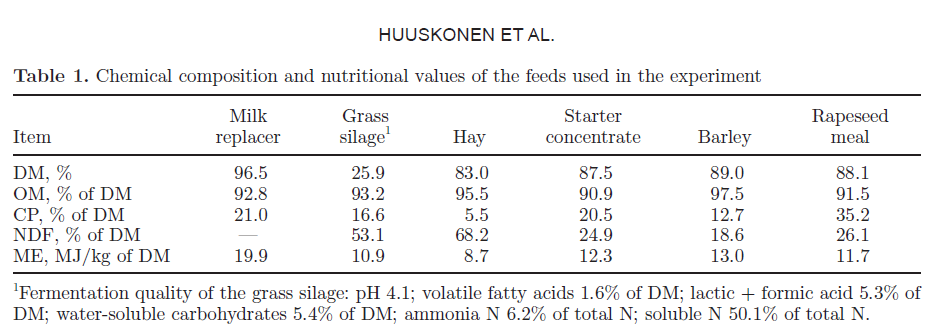
The average chemical composition and calculated nutritional values of the feeds are presented in Table 1 The fermentation quality of silages was good, as indicated by low pH values and low contents of ammonia
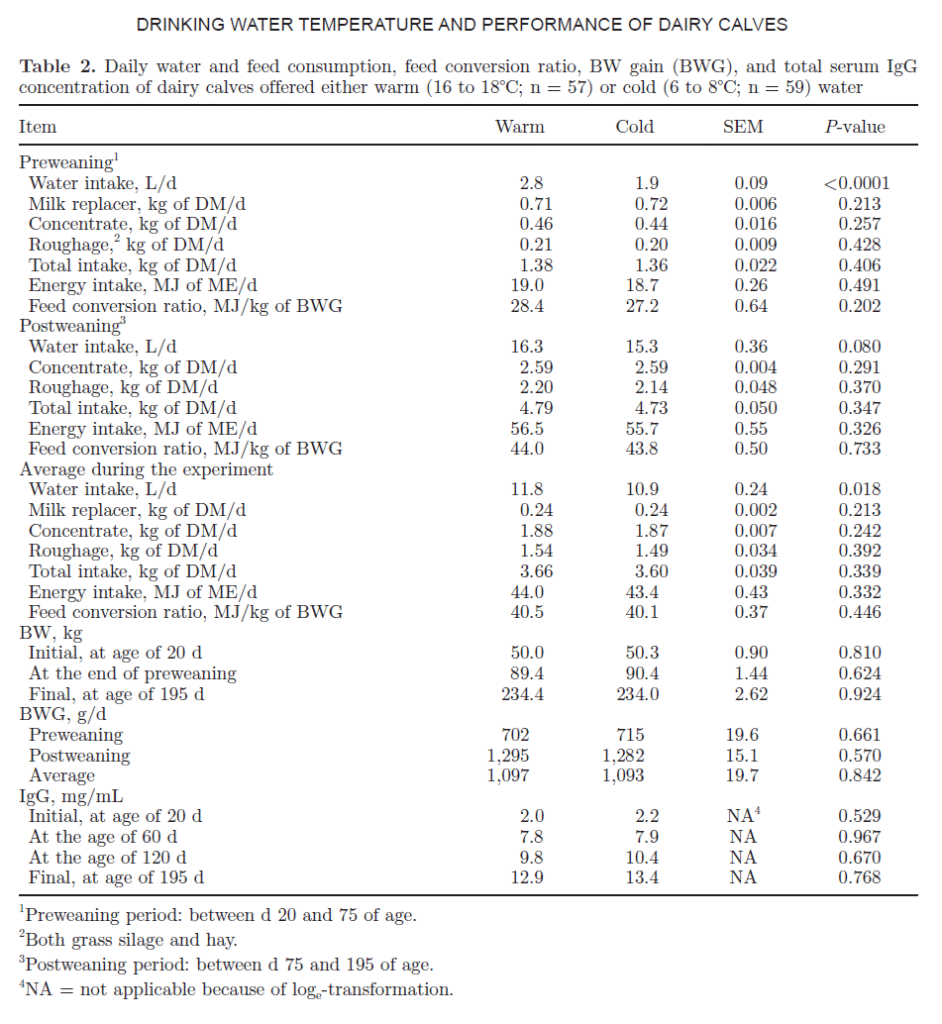
N and fatty acids. The silages used were restricted fermentation with high residual water-soluble carbohydrates concentration and low lactic acid concentration.The calves in both treatments consumed less than 2 L of water daily between 20 and 62 d of age (Figure 1), which is similar to the amounts reported by Kertz et al. (1984) and Thomas et al. (2007). During the preweaning period, the water intake of the W calves was 47% higher (P < 0.001) compared with that of the C calves (Table 2). Water intake in both treatments increased rapidly during weaning and for a few days following weaning (Figure 1), which is in accordance with the results of Hepola et al. (2008). From 180 to 195 d of age the calves consumed approximately 18 to 20 L of water daily. Calves offered warm water drank 7 and 8% more water during the postweaning period (P < 0.10) and overall (P < 0.05), respectively, compared with those offered cold water. However, these differences were not significant. Also with dairy cows, Osborne et al. (2002) reported that cows consumed more of the heated (30 to 33°C) drinking water than water at ambient (7 to 15°C) temperature.
During the preweaning and postweaning periods, the average DMI of the calves was 1.37 and 4.76 kg of
DM/d, respectively, and the energy intake was 18.9 and56.1 MJ of ME/d, respectively. Treatment did not affect
DM or energy intake (Table 2). The average BWG of the calves during the preweaning and postweaning
periods and during the entire experiment were 708, 1,288, and 1,094 g/d, respectively, which is in accordance
with the results by Huuskonen et al. (2005) and Huuskonen and Khalili (2008), with dairy bull calves
fed diets based on MR, grass silage, and grain in a similar housing environment. No differences in BWG,
feed conversion rates, or BW were observed at the end of the weaning phase or at 195 d (Table 2). It can be
concluded that the higher water intake of the W calves did not affect any measured intake or performance parameter compared with the C calves.
In total, 33% of the calves were treated at least once by a veterinarian (16 C calves and 23 W calves). The
proportion is quite high but Roth et al. (2009), for example, reported an even higher proportion (49%).
According to Roth et al. (2009), the high proportion of treated calves underlines the high risk that is associated with regrouping of calves of young age originating from different farms. In total, respiratory diseases were treated 27 times (treatment C: 9 calves; treatment W: 18 calves), omphalitis 6 times (C: 4 calves; W: 2 calves), dermatitis 6 times (C: 2 calves; W: 4 calves), and arthritis 3 times (C: 1 calf; W: 2 calves). Diarrhea was observed in 34% of the calves at least once (C: 21 calves; W: 20 calves) and bloating in 14% of the calves at least once (C: 9 calves; W: 8 calves).
Total serum IgG concentrations of the calves did not differ during the preweaning or postweaning periods
(Table 2). The immune status of the calves was determined because it can be used as an index for long-term
stress and disease susceptibility (Broom and Johnson,1993). The assumption that stress influences host immunity arises from observations of increased disease occurrence in animals exposed to extreme, stressful environments (Blecha, 2000). In the present experiment, no differences were observed between treatments in immune status or health of the calves; thus, no evidence existed that the intake of cold water (6 to 8°C) was a health risk for the calves.
CONCLUSIONS
The water consumption of calves was higher in calves offered warm water compared with those offered cold water during the preweaning period. However, the increased water intake of the calves offered warm water did not affect any measured intake or performance parameter compared with the calves offered cold water.
ACKNOWLEDGMENTS
The authors thank the Employment and Economic Development Centre for Northern Ostrobothnia (Oulu,
Finland), MTT Agrifood Research Finland (Jokioinen, Finland), Savonia University of Applied Science (Iisalmi,
Finland), and A-Farmers Ltd. (Atria, Finland) for financial support. The authors thank Lauri Jauhiainen for advice on statistical analysis. The authors also express their gratitude to Matti Huumonen and his staff
at Animal Production Research in Ruukki for technical assistance and excellent care of the experimental animals. The personnel at Animal Production Research in Jokioinen are also thanked for the laboratory analyses.