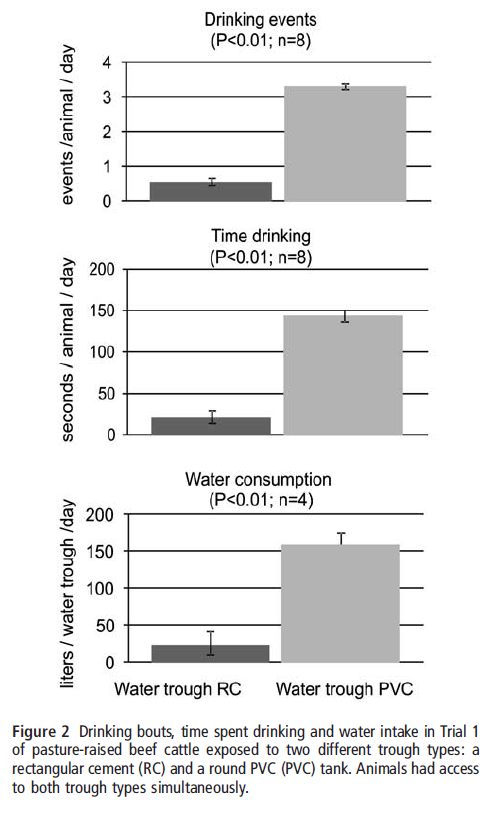
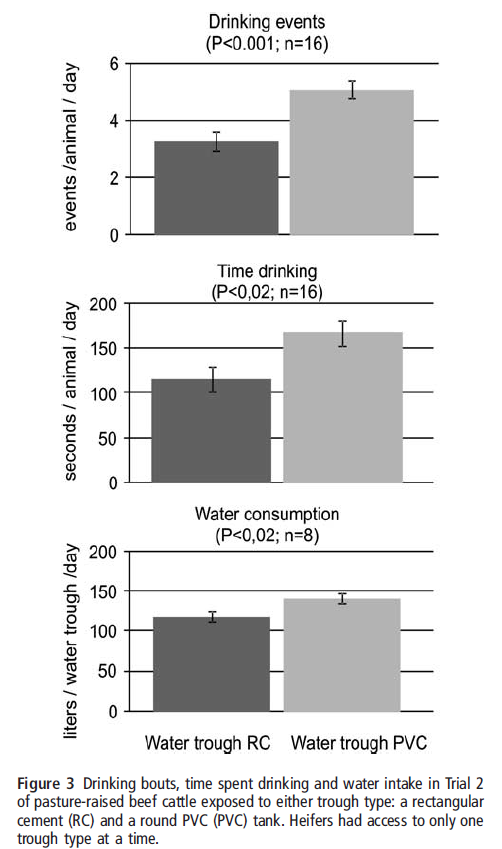
The objective of this study was to investigate the effects of different trough types on the water consumption and drinking behaviour of pasture-based beef heifers. Two trials were implemented with 32 beef heifers to test two different types of water troughs, namely a rectangular concrete trough (RC) and a round polyvinyl chloride water tank (PVC). In Trial 1, both troughs were simultaneously available to groups of four animals within eight paddocks. In Trial 2, the animals were distributed in pairs throughout 16 paddocks and, in a crossover design, were exposed to one type of trough at a time. In both trials, estimated water intake was per four animals. Number of drinking bouts, time spent drinking and amount of water intake from the RC and PVC trough were recorded in both trials. Data were statistically analysed by analysis of variance. In Trial 1, group and trough effect were in the model. In Trial 2, stage, pair and trough were tested. In Trial 1, where both types of troughs were available, animals had a higher number of drinking bouts (3.32 v. 0.57 6 0.09; P , 0.01), longer drinking periods (144.21 v.22.81 6 7.3 s; P , 0.01) and greater intake (160.21 v. 23.76 6 13.06 l; P , 0.01) from the PVC water tank, compared to the RC trough. In Trial 2, all groups drank more often (5.10 v. 3.28 6 0.32; P , 0.001), for longer periods (167.23 v. 115.23 6 15.61 s; P , 0.02) and with higher intake (141.36 v. 118.47 6 5.01 l; P , 0.02) from the PVC than from the RC trough. Thus, heifers not only prefer, but also drink more from a PVC water tank in comparison to a RC trough.
Keywords: drinking behaviour, water trough, pasture-based cattle
Implications
Water is a major nutrient for all animals, affecting dry matter intake, health and productivity. Our research shows that pasture-based beef cattle have preferences over what type of water trough to drink from and that the trough type offered may affect water consumption as well. When exposed to two types of water troughs, a rectangular concrete trough and a round polyvinyl chloride (PVC) tank, cattle drank more often, for longer periods and with higher intake from the PVC trough. Maximizing water intake is a low-cost investment with immediate results and prompt rewards that may still affect production and welfare positively.
Introduction
Brazil has the largest cattle herd in the world (FAO, 2008), and most of its beef production relies on pasture. Water supply may be a major constraint on the welfare, health and productivity of cattle on pasture. It is known that if given the choice, cattle will drink more often from a water trough than from a stream or pond (Sheffield et al., 1997; Bica, 2005). Despite prevailing recognition of the nutrient value of water (NRC, 2000), few plans and investments are made in relation to animal water supply, especially when dealing with pasture-based systems. This is particularly evident in pasture-based beef cattle farming, where secular traditions of herd handling generally supplant techniques. Water access may perhaps be more important than quantity. Factors which interfere with animal access to resources, such as water and feed, are space per animal, density and distribution of animals, quantity of available resources, time at hand when resources are accessible and internal social organization of the group (Albright, 1993; Ho¨ tzel et al., 2003). Using tanks instead of direct natural sources of water, as preferred by cattle, enhances water intake and animal weight-gain, hence improving animal performance and welfare, and economic and environmental efficiency (Bica et al., 2006).
Cattle prefer tanks to natural bodies of water in as much as the trough design can affect water intake among cattle and other animal species. Nyman and Dahlborn (2001) observed a greater water intake from buckets when com- pared to automatic troughs among horses, possibly due to greater ease for drinking. Sows prefer suspended nipple drinkers with heights varying from 51 cm to 76 cm (Phillips et al., 2001). Newborn piglets, on the other hand, prefer bowl drinkers of wider formats (Phillips and Fraser, 1990). Greater consumption rates among animals with favoured supplies suggest that productive systems should take their forms into consideration for possible increases of pro- ductivity, of animal welfare and of profits for producers.
Animals apparently seek a more comfortable, less energy-consuming way of obtaining water. Studies have demonstrated that cows prefer certain types of troughs and that they drink more water when provided in preferred tanks. Dairy cows prefer larger troughs with larger surface areas (Machado Filho et al., 2004; Teixeira et al., 2006). When water is restricted, social dominance interacts with physiological states and dominant lactating cows drink more water; subordinate dry cows can stay up to 48 h without drinking any water (Ho¨ tzel et al., 2003).
When studying water supply, beef cattle have received less attention than dairy cows. The impact of lack of water on dairy production is immediate. To produce a kilo of milk, a cow must consume 3 to 5 l of water (National Research Council, 2001), and, as such, the effect of water intake is more evident in dairy than in beef cattle. Although the relevance of the matter has already been demonstrated for dairy cows (Ho¨ tzel et al., 2003; Machado Filho et al., 2004; Teixeira et al., 2006), until today we do not know of any study which has analysed the influence of trough type on the water intake of pasture-based beef cattle. Hence, the objective of this study was to uncover the influence a trough type might exert on the drinking behaviour and water intake of pasture-based beef heifers.
Material and methods
The experiment was carried out in the experimental station of the Agronomical Institute of Parana (IAPAR, Instituto Agronoˆ mico do Parana´) in the municipality of Paranavaı´, in the South of Brazil, at the geographic location of 238050 S and 428260 W, with an average altitude of 480 m. The area of the experiment, with 5.3 ha, was equally divided into eight paddocks. Pasture was composed of Coastcross (Cynodon dactylon [L] Pers cv. Coastcross-1) intercropped with Pinto Peanut (Arachis pintoi Krapovickas y Gregori). Thirty-two beef heifers, crossbreds of Red Angus and Nelore, with the average age of 17 months and weight of 295 6 46 kg were used. Management of pasture was of continuous grazing with variable (put-and-take) stocking rate (Wheeler et al., 1973).
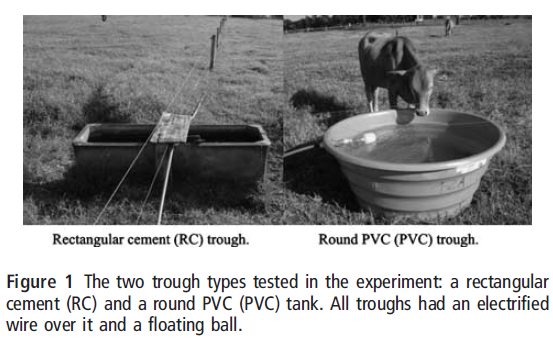
Two water troughs were compared in terms of number and duration of drinking bouts per heifer, and of water intake per trough. One was a rectangular concrete trough (RC) with a 300 l capacity of water of 0.5 m width 3 1.5 m length 3 0.5 m height. The other was a round blue polyvinyl chloride water tank (PVC) with a 500 l capacity of 0.6 m height and 1.2 m diameter. The surface areas of the troughs were, respectively, 0.75 and 1.13 m2. The former RC trough is very popular among beef farms of this region of Brazil and for this reason was elected for the study. The PVC trough was chosen for this experiment for it is quite similar to troughs that have been found to be preferred by dairy cows in previous ethological studies (Machado Filho et al., 2004; Teixeira et al., 2006) and is easily obtainable; hence, the comparison.
Water level of both troughs was controlled by a floating ball with automatic supply. Both troughs were supplied with the same water, from the network of a single pumping station. For a 30-day period before the experiment, all animals were simultaneously exposed to both troughs. Before the 30-day period, only the RC trough was available. Before the experiment, all troughs were checked for leaks and cleaned. The experiment was divided into two trials:
Trial 1: Evaluation of the preference of beef heifers between two water trough types
In this trial both trough types were available throughout the whole period, and heifers could choose to drink from either one. The frequency of the heifers’ drinking bouts at both trough types was recorded. The experimental design was a CRD (completely randomized design). The 32 heifers were randomly distributed to the eight paddocks in groups of four. Both trough types were positioned alongside the fence of two adjacent paddocks, thus attending to two paddocks at the same time. All troughs had an electrified wire over it. This did not interfere with access because the space available (0.5 3 0.75 m in RC troughs and a 0.6 m radius in PVC troughs) allowed free access to the water (Figure 1). The eight neighbouring animals of each paddock had thus free access to both the RC and the PVC tank. Behavioural observations were made daily from 0700 to 1900 h, for three consecutive days.Trial 2: Evaluation of water intake of heifers with exclusive access to each of the two different water trough types This trial tested if access to either trough affected consump- tion, as animals were given access to only one of the trough types tested in Trial 1. The trial was carried out in two stages,volume of ingested water of the eight animals at each trough was taken into account. Therefore, for the analysis of behaviours, the group of four heifers (n 5 8) was regarded as the experimental unit, whereas for water intake, the eight animals at each trough (n 5 4) were regarded as the experimental unit. The model used for analysis of variance of Trial 1 was:
Yijk ¼ m þ Gi þ Bj þ eijk;
where Yijk was the value of the dependent variables, m the average value, Gi the groups’ effect, Bj the tested troughs’ effect and eijk the random error N(0, s 2).
Trial 2 was based on a crossover experimental design, where all heifers participated in both trough treatments. Daily averages of number of drinking bouts and time spent drinking of each animal pair, in each treatment, were thus considered. The daily average volume of ingested water of the four ani- mals of each trough was regarded as intake. For the analysis of behaviours, each pair of heifers (n 5 16) was considered an experimental unit; for water intake, the two pairs using the same trough composed a unit (n 5 8). The model used for the analysis of variance of the crossover design was:
Yijkl ¼ m þ Si þ Pj þ Bj þ eijkl;
where Yijkl was the value of the dependent variables, m the average value, Si the effect of the stages, Pj the effect of the pair (or of the group of four animals), Bk the effect of the tested troughs, and eijkl the random error N(0, s2).
Results
In Trial 1, when animals had access to both water trough types, the number of drinking bouts, time spent drinking and water intake was greater in the PVC than in RC water tank (Figure 2).
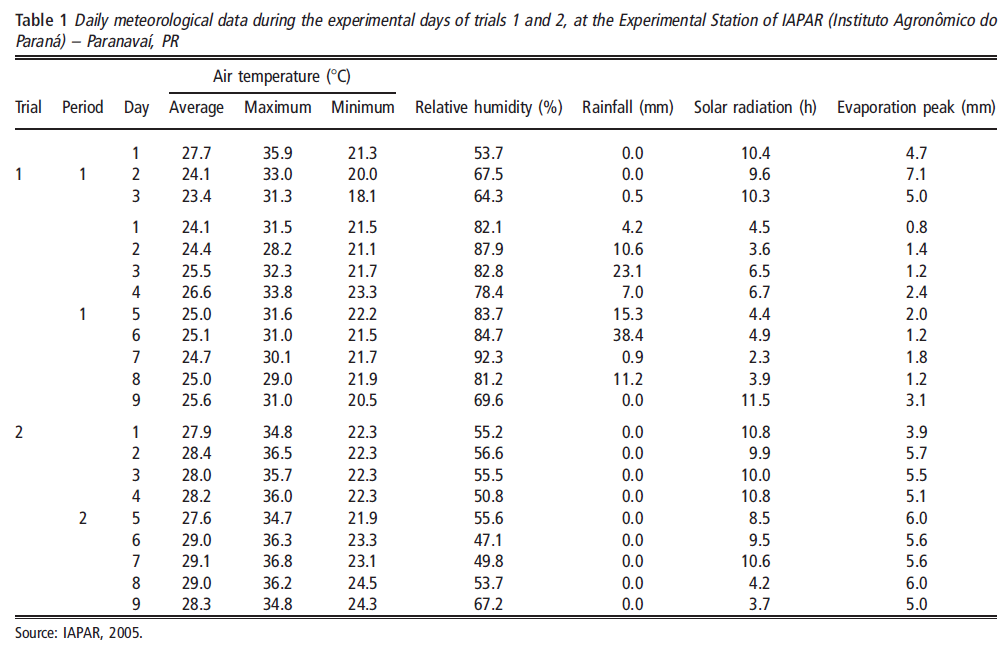
As in Trial 1, in Trial 2, heifers with access to only one trough type at a time drank more often for longer periods and had a higher water intake when the PVC water trough was available (Figure 3). During the first stage of Trial 2, air temperatures were lower and relative humidity was higher than the second stage (Table 1). Accordingly, in the second stage, heifers individually spent more time drinking (98 v. 184 6 15 s/day; P 5 0.001) and water intake by the group
was greater (113.9 v. 145.9 6 5.5 l/day; P 5 0.006).
Discussion Various factors may have led the heifers to use the PVC trough more. This round and polyvinyl chloride tank was larger, whereas, the rectangular and concrete trough was smaller and lower. Trials with dairy cattle have been con- ducted in order to disclose the physical factors that effec- tively influence cow trough preference. Machado Filho et al. (2004) have revealed that cows prefer larger troughs, with greater water surface and depth. These authors verified a greater number of drinking bouts, time spent drinking andwater intake at a larger trough (60 cm height; 139 3 95 cm) over a smaller one (30 cm height; 126 3 68 cm). In another experiment, Teixeira et al. (2006) tested preference, compar- ing two different troughs in terms of surface area, height and depth. Their findings attested to a relation between the water surface and the animals’ preference: drinking bouts were more frequent, time spent drinking was longer and water intake was greater from the trough of larger water surface.
As in Trial 1 of this experiment, Teixeira (2005) also tested the drinking behaviour of dairy cows in troughs of different formats and sizes. In this particular study, three distinct but commonly utilized troughs in pasture-based systems were compared by means of preference trials: one was a round 500 l trough (60 cm height 3 120 cm dia- meter), another a round 125 l trough (60 cm height 3 60 cm diameter) and a third rectangular 100 l trough (30 cm height 3 100 cm length 3 60 cm width). The animals pre- ferred the first trough, having there drank more often, spent more time drinking and ingested more water.
The latter-favoured trough had the same dimensions of the most utilized trough in this experiment. This thus indicates that pasture-based bovine, dairy cows and beef heifers prefer troughs of larger water surfaces, quite like the PVC trough of this study.
Water temperature and quality may also influence water consumption. Differences in water temperature may affect intake by cattle (Andersson, 1985; Lardy and Stoltenow, 1999; Osborne et al., 2002). However, minor differences in water temperature are not likely to influence intake (Murphy, 1992). Water quality, especially mineral content, manure or chemi- cal contamination and other factors that affect odour and taste may also affect water intake (NRC, 2001; Wright, 2003; Lardner et al., 2005). In this experiment, water of all troughs came continuously from a single public water supplier. As such, because the water of all troughs was potable, of the same temperature and composition, it is unlikely that differ- ences in trough preference or water intake be accounted for by any other reason than the trough itself.
The troughs of this experiment had different perimeters, and it is known that social hierarchy affects drinking behaviour, especially when water consumption is limited (Ho¨ tzel et al., 2003). One may, therefore, consider that heifers preferred and drank more from the PVC trough due to its larger perimeter. When free access is granted, tech- nical extensionists have recommended a minimal surface perimeter for 20 heads of beef cattle of 0.5 m for circular troughs and of 0.7 m for rectangular troughs (Pinheiro Machado, 2004). In this study, troughs were permanently accessible, and perimeters were 2 m for the RC and 3.85 m for the PVC. As a result, one can assume that both troughs were fully capable of attending to the four animals of each paddock, therefore, possibly forwarding the explanation for preference to further characteristics of the trough itself.
Identifying animal preference of water trough and ver- ifying if this preference converts into greater intake are of great relevance, for it may be directly linked to the con- sumption of food, to animal production (National Research Council, 2000), and perhaps to welfare. In this experiment, water intake further attested to the preference of the most sought for PVC trough, when heifers could yet opt for either kind of trough. In the same manner, Machado Filho et al. (2004) have found that dairy cattle drank more water from the preferred tank in a previous test. In commercial rearing operations, both the planning of installations as well as the handling of animals is exclusively conducted in accordance with economic results. Nevertheless, aspects related to animal behaviour, which may yet have expressive and immediate results at a very low cost, are normally dis- carded. As an example, a trough is generally chosen and planned for according to its cost and not to its efficiency and economic result.
The estimated daily average intake per animal at the troughs was 29.6 l at the RC trough and of 35.6 l at the PVC tank. The total daily requirements of water intake (water contained in feed, produced by the body’s metabolism and of free intake) for beef heifers with an approximate weight of 273 kg ranges from 29.5 to 48.1 l, in average tem- peratures of 21.18C to 32.28C (National Research Council, 2000), as were the conditions of this experiment. The heifers were, hence, drinking adequate amounts of water according to the indications of the NRC. Water consumption is highly associated to the intake of dry matter (National Research Council, 2000). Even though we did not measure the dry matter content of the heifers’ diet, we may consider that the content of both treatments was equal, since the paddocks were set up on the same pasture. A greater free intake of water, as such, may stimulate a greater intake of feed and, consequently, a greater weight-gain. This is the explanation of Bica et al. (2006) for greater weight-gain of pasture-based beef cattle which had either a trough or a natural rain basin as water source. The experiment was conducted under high tempera- tures, during the hottest months of the summer, when the average temperature was above 258C. Temperature and humidity have a direct relation with water consumption among cattle (Murphy et al., 1983; Murphy, 1992; Rouda et al., 1994). Additional water requirements of young calves are 0.5 l/day for each additional degree Celsius of air tem- perature (Meyer et al., 2006). In this study, this tendency was also observed: in Trial 2, time spent drinking and intake increased in the second stage, thus, in accordance to the hotter and dryer conditions of the weather at the time. Other authors have also noted a correlation among cattle between water intake and rises in air temperature and falls in relative humidity (Meyer et al., 2004). Loneragan et al. (2001) have found the daily average temperature to be responsible for 25.7% of an observed variation in water consumption.
We conclude that the trough type not only affected the drinking behaviour of pasture-based beef heifers but water intake as well. Observations show a preference, leading to increased intake, for round PVC tank water over RC trough water.
Acknowledgements
We acknowledge CAPES for sponsoring Paula Coimbra. We are grateful to the students that helped collect data, especially Alexandra Dalpasquale, Joa˜o H. Costa and Juliana Faveri. We also acknowledge IAPAR for allowing the research to take place in Paranavaı´’s experimental station.