Amit Kumar Singh1 · Champak Bhakat1 · Pooja Singh2
Received: 24 September 2021 / Accepted: 24 March 2022
© The Author(s), under exclusive licence to Springer Nature B.V. 2022
Abstract
In this changing climate scenario, the availability of potable water has become scarce for both humans and animals in many parts of the world. Continuous supply of water is crucial for animals’ life as well as different body and sanitary maintenance needs. Water availability has a direct and indirect role in clenching thirst, feeding, cleaning of animals and their environment,and other dairy operations. Water intake by dairy animals is affected by several factors including body weight of animals,genetic makeup, dry matter intake, mineral content of feed offered, milk productivity, environmental conditions, and water temperature. Behavioral patterns of dairy animals are adversely affected by restriction of water supply to them. Researchers have recommended that ad libitum water supply should be assured to the farm animals to avoid any negative effect on their health and performances. In the recent years, there is growing interest in quantifying the effects of restricted water supply to dairy animals. Many studies have demonstrated that the availability of potable water for animals will be a great challenge soon. Therefore, the present review paper has been formulated to gain better understanding of the factors affecting water intake in dairy animals and management strategies to ensure availability of water resources essential for their health, production, and well-being
Factors and management practices associated with water intake in dairy animals.
A wide range of factors determines the intake of water by a particular animal. However, categorically, the factors may be classified into majorly five types’ viz., animal’s factors, management practice–related factors, environmental factors, feeds and water offered to the animals, and the watering management practices. In coming sections of this manuscript, these factors will be discussed in detail. Figure 1 represents the major factors that affect water intake in dairy animals.
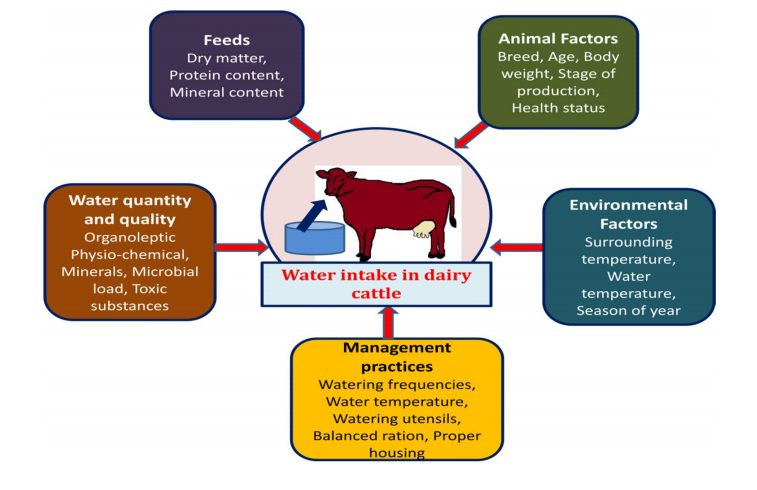
Due to space restrictions, we will concentrate on the section about environmental factors.
Environment factors
Water temperature
Any alteration in 14, offered to the animal, may affect their drinking behavior. Golher et al. (2021) remarked that the difference between the water temperature and body temperature of the animal should be kept minimum for enough water consumption by dairy cattle. Bewley et al. (2008) found that prolonged water temperature consumed by dairy cows may affect reticular temperatures. Singh (2002) studied the impact of three water temperatures, viz., 37 °C, 25 °C, and 15 °C, on the drinking behavior of crossbred dairy cows and found higher water intake at 37 °C as compared to other groups. However, Beck et al. (2000) reported no difference in productive performance in animals provided with different temperature of water, viz., 17 °C and 24 °C. In line with that, Pereyra et al. (2010) conducted a series of 3 experiments and clubbed them into one study on water impact on dairy cattle performances. They revealed that water temperatures, viz., 18 °C and 31 °C, had no effect on water consumption by dairy cows. However, they remarked that fresh water should be made available to the dairy animals to improve thermoregulation and subsequently their performances especially under heat stress conditions. Nonetheless, Pereyra et al. (2010) also observed, in another set of trial in same study, that the provision of simple cloth shade over the water trough may significantly affect water temperature which may modify water intake behavior of dairy cattle.
In high altitude conditions where surrounding temperature remains predominantly cooler and the low temperature of water may lead to loss of energy from animal’s body whereas on the other hand warmer drinking water temperature may positively relieve cattle from cold stress conditions. Golher et al. (2014) exposed crossbred dairy cattle at high Himalayan altitude to three temperature levels, viz., 10.25 °C, 15–20 °C, and 35–40 °C, and demonstrated that warm water can improve productive performance of animals. Besides, the highest water and dry matter intake, as well as milk production, was observed when warm water
was offered to animals. Result of the study also suggested that warm water may help in conserving energy of cattle by relieving from cold stress as shown by improved physiological parameters of crossbred dairy cattle at high Himalayan altitude (Golher et al., 2015). The above discussion concludes that for dairy animals,
cool water temperature at tropical areas and warm water temperature at high altitude areas should be preferred for augmenting performances of dairy animals. Extreme limits of water temperature should be avoided for production and health losses of dairy cattle. More extensive studies should be conducted for more water temperature levels at both tropical and high altitude areas for recommending at specific comfortable zones of water temperatures throughout the world.
Season of the year
Ruminants have special mechanism of thermoregulation to maintain their homeothermy when they are in thermoneutral zone. Thermoneutral zone of Bos taurus cattle is around 13 to 18 °C (NRC, 1981; Das et al., 2016; Singh et al., 2020a; Singh, 2021). For Bos indicus, thermoneutral zone is 15 to 26.7 °C (Prasad and Neeraj, 2010). Any deviation of temperature from this range may create discomfort for dairy cattle and negatively impacts their behavior, health, and production specially when the temperature crosses the upper or lower critical levels. Nagarcenkar (1979) reported that when the surrounding temperature rises above 35–35 °C, even tropically acclimatized zebu cattle consume 40% water more than thermoneutral zone temperature. Osborne et al.(2002a, b) reported that seasonal effects prevail and both Jersey and HF cows consumed warmer water (30–33 °C) in cool climate (7–15 °C). However, heat and cold stress may
elevate water consumption in dairy cattle. During heat stress, cows drink more to combat the ill effects of heat by improving thermoregulation and lowering water losses, whereas in cold stress conditions, cows consume more dry matter to cope with cold season so the water intake of dairy cows may elevate simultaneously (Shalit et al., 1991).
Feeds ingested by the animals
Depending upon water content of the feed, water intake of dairy cattle is directly and positively correlated with dry matter intake (Broucek, 2019; Singh et al., 2020b; Golher et al., 2021). This implies that the more the dry matter intake occurs, the more will be water intake in dairy cattle. Decline in water intake may lead to decreased dry matter intake. Several studies have demonstrated a high and positive correlation between concentrate intake and water intake (Quigley et al., 2006; Singh et al., 2020d). De Passillé et al. (2011) suggested that there is no association between hay intake and water intake; however, they demonstrated a significant correlation of concentrate intake with water intake. Brew et al. (2011) reported a positive correlation of dry matter intake and body weight gain with the amount of water intake by dairy cattle. In other studies (Kramer et al., 2009; Kume et al., 2010), a direct corroboration of water intake with dry matter was reported. However, it should be noted that when amount of water is sufficient to fulfill physiological needs of dairy cattle then extra water intake may not lead to higher dry matter intake by them (Broucek, 2019). In connection to above discussion, it may be interesting to note that water intake measurement may assist in estimating the changes in dry matter intake following which health and estrus status can be evaluated in dairy cattle (Lukas et al., 2008).
Protein content in the diet has a direct role in the water intake by dairy cattle. Holter and Urban (1992)
reported that by increasing dietary protein, higher water intake can be achieved in cows during the dry period but not during lactation. However, Divya et al. (2011) found no impact of supplementing dairy heifers with different levels of un-degraded dietary protein on the water intake by them. Notwithstanding the results of above cited studies for lactating cows, a study conducted by Panjaitan (2010) revealed that spirulina may be used in animal’s drinking water as a protein and mineral source. Durand-Chastel (1980) found that spirulina contains micro-minerals useful for dairy cattle including K, Na, Ca, Mg, Fe, Zn, Cu, and Mn. Panjaitan et al. (2010) investigated that the addition of spirulina increased the water intake in dairy cattle. The reason behind this may be the higher protein and mineral addition in the overall diet of cattle supplemented with spirulina. In a latest study by Kumar et al. (2021), three different protein sources were provided over and above the standard diet to Gir cows, viz., urea at 75 g/cow, mustard cake at 614 g/cow, and guar meal at 505 g/cow, and the water and dry matter intake was studied. Study revealed that highest water intake and correspondingly the highest dry matter intake were observed in response to guar supplementation followed by mustard oil cake and urea. From their study, they concluded that Guar meal may significantly improve water intake and dry matter intake in dairy cows than other protein sources.
Studies have revealed that mineral contents of the diet especially Na may have a direct impact on water intake of dairy cattle. Spek et al. (2012) conducted an experiment on the effect of four levels of dietary Na in lactating dairy cattle, viz., 3, 9, 14, and 19 Na (g/kg dry matter of diet), respectively. Significant increase in water intake was noticed in association with increased dietary Na levels. At 19 g Na/kg dry matter, highest water intake (115.7 kg/day/cow) was observed followed by 90.9 kg/day/cow water intake in cows with 14 g Na/kg dry matter, 82.1 kg/day/cow water intake in cows with 9 g Na/kg dry matter, and 61.7 kg/day/cow water intake in cows with 3 g Na/kg dry matter. Several studies reported an increased amount of 0.146 kg/day/cow (Spek et al., 2012), 0.054 kg/day/cow (Murphy et al., 1983), or 0.406 kg/day/cow (Meyer et al.,2004) water intake with each additional grams of Na in the diet of dairy cows.